





What's in this guide
01 The real cost of ungoverned data
02 What is a data governance framework?
03 The five core pillars of a data governance framework
04 Key components every framework must include
05 Data governance framework vs data management
06 How to implement a data governance framework: a practical roadmap
07 Data governance tools and technology
08 Data governance best practices for 2026
09 Common mistakes that derail governance programmes
10 Measuring success: governance KPIs and maturity models
11 Frequently asked questions
The real cost of ungoverned data
In 2023, a major European bank was fined 390 million euros for GDPR violations that traced back to one root cause: no one knew which systems held customer data, who had authorised its use, or how it had been shared. The data existed. The infrastructure existed. What was missing was a data governance framework, the formal layer of policies and accountability that would have made that data traceable, controlled, and compliant.
That is not an edge case. It is the predictable outcome of treating data as a technical asset rather than a governed one. And in 2026, the consequences have only grown sharper.
Three forces have made data governance a board-level priority this decade:
- Regulatory pressure: The EU AI Act, GDPR, CCPA, HIPAA, and a growing wave of national AI regulations all require organisations to demonstrate that their data is accurate, traceable, and used appropriately. Governance is no longer optional, it is the legal foundation.
- AI dependence: Every AI model your organisation trains or deploys is only as trustworthy as the data it consumed. Without governance, your AI inherits every bias, error, and inconsistency in your data estate, silently and at scale.
- Strategic cost: Gartner estimates that poor data quality costs organisations an average of $12.9 million per year. Every dashboard that contradicts another, every merger integration that fails to reconcile data models, every AI pilot that underperforms, these are governance failures with a price tag.
What is a data governance framework?
A data governance framework is a structured system that defines how an organisation manages its data. It covers not just the technology, but the people, processes, policies, and accountability structures that ensure data is accurate, consistent, secure, and used appropriately across the enterprise.
The distinction that most organisations miss early is this: a data governance framework is not a software platform. Technology supports it, but the framework itself is organisational. It answers fundamental questions that no tool can answer on its own:
- Who is responsible for the accuracy of this dataset?
- What standards must this data meet before it is used in a model or report?
- Who is permitted to access, modify, or share this data, and under what conditions?
- How do we detect and correct data quality problems before they reach downstream systems?
- How do we demonstrate compliance with GDPR, the EU AI Act, or HIPAA to a regulator?
A mature data governance framework brings together five interdependent disciplines into a coherent operating model: data quality, data stewardship, metadata management, data security and privacy, and regulatory compliance. Each discipline requires its own policies and owners, but they must function as a system, not as isolated projects.
Governance without accountability is documentation. Accountability without governance is chaos. A framework is what makes them work together.
In 2026, the scope of data governance has expanded significantly. Where earlier frameworks focused primarily on structured data in warehouses, modern frameworks must govern unstructured data, real-time streams, AI training datasets, and the outputs of generative AI systems. The framework must be as dynamic as the data estate it governs.
The five core pillars of a data governance framework
Every effective data governance framework rests on five pillars. These are not sequential steps, they are simultaneous, interdependent disciplines that must all be active for governance to function. Weakness in any one pillar compromises the others.
1. Data quality and integrity
Governance begins with ensuring that data is fit for purpose: accurate, complete, consistent, and timely. Data quality is not a one-time cleansing exercise, it is a continuous discipline enforced through automated validation rules, quality SLAs, and accountability structures that assign ownership for quality at the source.
- Define data quality dimensions: accuracy, completeness, consistency, timeliness, uniqueness
- Implement automated validation at ingestion, not just at reporting
- Assign data quality ownership to data stewards, not just engineering teams
- Track quality scores over time and tie them to SLAs with downstream consumers
2. Data stewardship and ownership
Every critical data domain, customer, product, financial, operational, must have a named human owner. Data stewards are responsible for defining business rules, resolving quality issues, approving access requests, and maintaining data definitions in the business glossary. Without stewardship, governance frameworks become policy documents that no one enforces.
- Appoint data stewards for each critical data domain, not just IT
- Define steward responsibilities formally: quality, definitions, access decisions
- Create a data governance council that meets regularly to resolve cross-domain issues
- Tie stewardship accountability to performance objectives
3. Metadata management and data catalogue
You cannot govern what you cannot find. A data catalogue, the searchable inventory of your data assets, their definitions, lineage, quality, and ownership, is the operational backbone of any governance framework. Without it, data stewards cannot do their jobs, analysts cannot find trusted data, and regulators cannot receive the documentation they require.
- Maintain a business glossary with agreed definitions for all critical data terms
- Catalogue every significant data asset with owner, lineage, quality score, and classification
- Integrate the catalogue with your data lineage tooling for end-to-end traceability
- Make the catalogue self-service: analysts should be able to find trusted data without IT tickets
4. Data security, privacy and access control
Governance determines who can see what data, under what conditions, and for what purpose. This pillar encompasses data classification (public, internal, confidential, restricted), role-based access controls, privacy by design, and the enforcement mechanisms that ensure sensitive data never reaches unauthorised systems or users.
- Classify all data assets by sensitivity and regulatory category
- Implement role-based and attribute-based access controls aligned to classification
- Automate PII masking in data pipelines before data reaches analytical environments
- Maintain a complete audit trail for all access to sensitive data domains
5. Regulatory compliance and audit readiness
In 2026, compliance is not a by-product of good governance, it is a design requirement. Your framework must be capable of generating the audit documentation that regulators require: GDPR Article 30 records of processing, EU AI Act technical documentation for high-risk systems, HIPAA audit trails, and SOX data controls. Governance as Code, automating compliance evidence from your data infrastructure, is the 2026 standard.
- Map each regulatory requirement to specific governance controls and owners
- Automate the generation of compliance reports from lineage and quality metadata
- Conduct regular governance audits, not just when regulators ask
- Treat the EU AI Act as a governance design requirement, not a post-hoc documentation task
Key components every data governance framework must include
A data governance framework is more than its pillars. The following components are the operational mechanisms that make the pillars functional in a real organisation.
.png)
For organisations just starting out, focus on three components first: a data governance council with real authority, a business glossary covering your top ten critical data terms, and data quality monitoring on your three most important pipelines. Build from this foundation rather than trying to implement everything simultaneously.
Data governance framework vs data management: understanding the difference
These terms are frequently used interchangeably, and the confusion is costly. Organisations that conflate them either over-invest in tooling before establishing governance, or mistake technical data management for the organisational accountability structures that governance requires.
.png)
Data management is the engineering of data infrastructure. Data governance is the social contract that determines how that infrastructure is used. Both are necessary. Neither substitutes for the other.
How to implement a data governance framework: a practical roadmap
Most data governance programmes fail not because the framework is wrong, but because implementation is approached as a technology deployment rather than an organisational change programme. The following roadmap is sequenced to build credibility, demonstrate early value, and create the accountability structures that sustain governance long-term.
PHASE 1
Establish governance foundations (months 1-2)
Secure executive sponsorship at CDO or C-suite level. Form a data governance council with cross-functional representation from business, IT, legal, and compliance. Define the scope of the initial programme, avoid trying to govern everything at once. Identify three to five critical data domains that carry the most regulatory or business risk.
Most programmes that fail do so in this phase, they start with tools, not accountability structures.
PHASE 2
Assess current state and define target (months 2-3)
Conduct a data governance maturity assessment across all five pillars. Document the current data landscape: source systems, critical data assets, existing quality issues, and compliance gaps. Define target-state governance capabilities for an 18-month horizon. This assessment becomes the business case for investment.
Organisations typically discover more regulatory exposure than they expected, this is the right time to find it.
PHASE 3
Build the stewardship model (months 3-5)
Appoint data stewards for each critical data domain. Define steward responsibilities formally. Publish a business glossary covering the top twenty critical data terms, starting with the ones that cause the most cross-departmental confusion. Hold the first governance council meeting to ratify the stewardship model.
The business glossary is typically the first governance artefact that business stakeholders find genuinely valuable.
PHASE 4
Implement data quality and lineage (months 4-8)
Deploy data quality monitoring on the three most critical pipelines. Instrument lineage tracking using OpenLineage or a compatible toolset. Establish quality SLAs with defined owners and escalation paths. Begin populating the data catalogue with the most critical assets.
The first time a data quality alert prevents a bad number reaching a board report, governance becomes self-funding.
PHASE 5
Extend to compliance and AI governance (months 8-12)
Map governance controls to regulatory requirements: GDPR, EU AI Act, HIPAA, SOX. Automate compliance report generation from lineage and quality metadata. Extend governance to AI training datasets and model registries. Begin regular governance audit cycles.
By this phase, governance is operational infrastructure, not a project, and the audit value becomes visible.
ONGOING
Sustain, scale and mature (year 2 and beyond)
Expand stewardship coverage to all significant data domains. Implement a formal data governance maturity model to track progress. Integrate governance into data product development processes, making governance a design requirement, not a post-hoc check. Publish an annual data governance report to the board.
Governance maturity correlates directly with data trust scores, AI model accuracy, and regulatory audit outcomes.
Data governance tools and technology
Technology does not create governance, but it makes governance scalable. The right tools automate enforcement, surface quality issues, maintain audit trails, and make data discovery self-service. The following categories cover the technology landscape that supports a modern data governance framework.
.png)
Data governance best practices for 2026
The following best practices represent the lessons of organisations that have moved from governance pilots to production-grade, enterprise-wide programmes. They are sequenced from foundational to advanced.
Start with business outcomes, not governance artefacts
Every governance initiative must be anchored to a business problem: reducing regulatory exposure, improving AI model accuracy, eliminating conflicting revenue metrics, accelerating audit response times. Governance programmes that start by building a data catalogue for its own sake invariably stall. Start with the business case and let it drive the artefacts.
Make governance a design requirement, not a retrospective audit
By the time a data quality problem surfaces in a board report or an AI model, the cost of fixing it is ten to one hundred times higher than preventing it at source. The most mature governance programmes embed governance requirements into the data product development lifecycle, requiring quality checks, lineage instrumentation, and stewardship assignment before a new pipeline goes to production.
Federated governance over centralised control
Centralised governance teams that try to own all governance decisions become bottlenecks and get bypassed. The most effective model in 2026 is federated governance: a central governance office sets standards and policies, while domain-level data stewards own enforcement within their business areas. This mirrors the data mesh architectural principle and works at enterprise scale.
Treat your AI data supply chain as a governance domain
Every AI model your organisation deploys has a data supply chain: the datasets used for training, the preprocessing logic applied, the quality checks that ran before training, and the ongoing data feeds used for real-time inference. Each element of that supply chain requires governance controls. The EU AI Act makes this a legal requirement for high-risk AI systems, but even where it is not legally required, it is operationally essential for trustworthy AI.
Measure governance maturity, not just governance activity
Running a governance council meeting is governance activity. Reducing the number of cross-departmental data conflicts by 40% is governance maturity. Mature programmes track metrics like data trust scores, quality SLA compliance rates, audit response times, stewardship coverage ratios, and time-to-insight. These are the metrics that demonstrate value to the board.
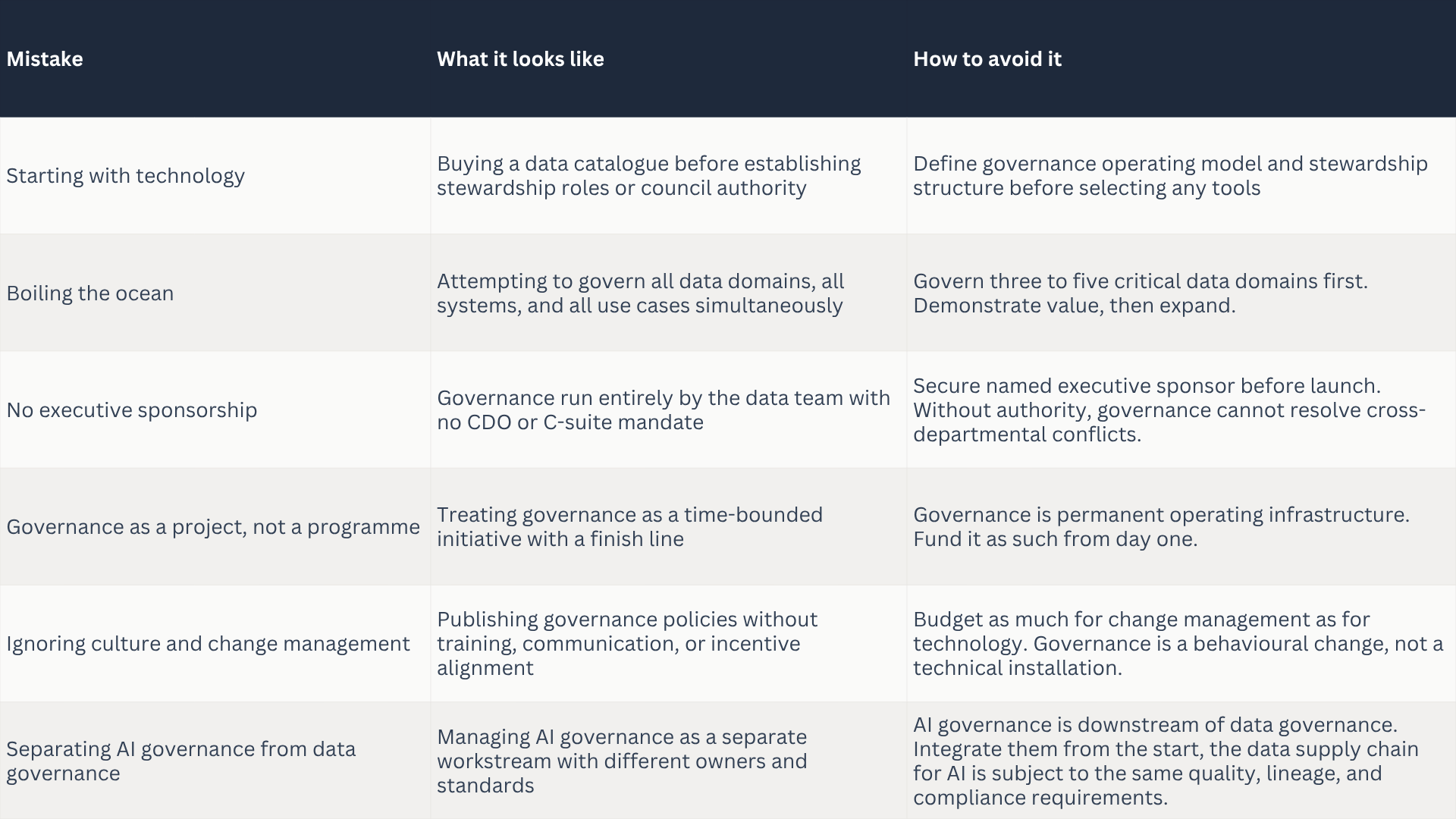
Common mistakes that derail data governance programmes
The vast majority of governance failures are predictable. Understanding these patterns before you encounter them is the most efficient form of risk management.
Measuring success: governance KPIs and maturity models
A data governance framework that cannot demonstrate its value will not survive its second budget cycle. The following KPIs translate governance activity into business outcomes that resonate with finance, legal, and executive audiences.
Operational governance KPIs
.png)
Data governance maturity model
.png)
Frequently asked questions about data governance frameworks
1. What is a data governance framework in simple terms?
A data governance framework is the formal system of policies, roles, and processes that determines how an organisation manages, protects, and uses its data. It defines who owns each data domain, what standards data must meet, who can access it, and how compliance with regulations is demonstrated and maintained.
2. What are the core components of a data governance framework?
The core components are: a data governance council with executive authority, a data stewardship programme with named domain owners, a business glossary with agreed data definitions, a data catalogue covering key assets, a data quality framework with automated monitoring, a data lineage system for traceability, access control policies aligned to data classification, and automated compliance reporting. Most organisations implement these progressively rather than simultaneously.
3. What is the difference between data governance and data management?
Data management covers the technical processes of storing, moving, and processing data, pipelines, warehouses, integrations, and data models. Data governance covers the policies, accountability structures, and rules that determine how data is owned, used, and controlled. Data management is an engineering discipline; data governance is an organisational one. Both are necessary, and neither substitutes for the other.
4. How do I start implementing a data governance framework?
Start with three things before any technology decision: secure executive sponsorship at CDO or C-suite level, form a governance council with cross-functional authority, and identify three to five critical data domains that carry the most regulatory or business risk. Define stewardship roles for those domains, build a business glossary covering the most contested data terms, and deploy quality monitoring on your most important pipelines. Build from this proven foundation rather than attempting enterprise-wide governance immediately.
5. What is the best data governance framework for 2026?
The most effective frameworks in 2026 are hybrid: DAMA DMBOK provides conceptual foundations across all eleven data management disciplines; cloud-native governance tools (AWS Lake Formation, Microsoft Purview, Google Dataplex) provide technical controls integrated with data infrastructure; and an internal operating model adapted from DGI or COBIT provides the accountability structures. The choice depends on your existing technology estate, regulatory environment, and maturity level.
6. How does data governance support AI compliance in 2026?
The EU AI Act requires high-risk AI systems to document every data source and transformation used in training, demonstrate bias-mitigation measures, and maintain reproducible model audit trails. Data governance provides the foundation for this: data lineage tracks the AI data supply chain, data quality frameworks ensure training data meets defined standards, and the data catalogue provides the documentation regulators require. Without governance, AI Act compliance is a manual, high-cost exercise, with governance, it is largely automated.