


Secure and govern your data at every stage
LakeStack applies governance from the moment data enters your foundation, so every dataset is controlled, traceable, and ready for analytics and AI from day one.
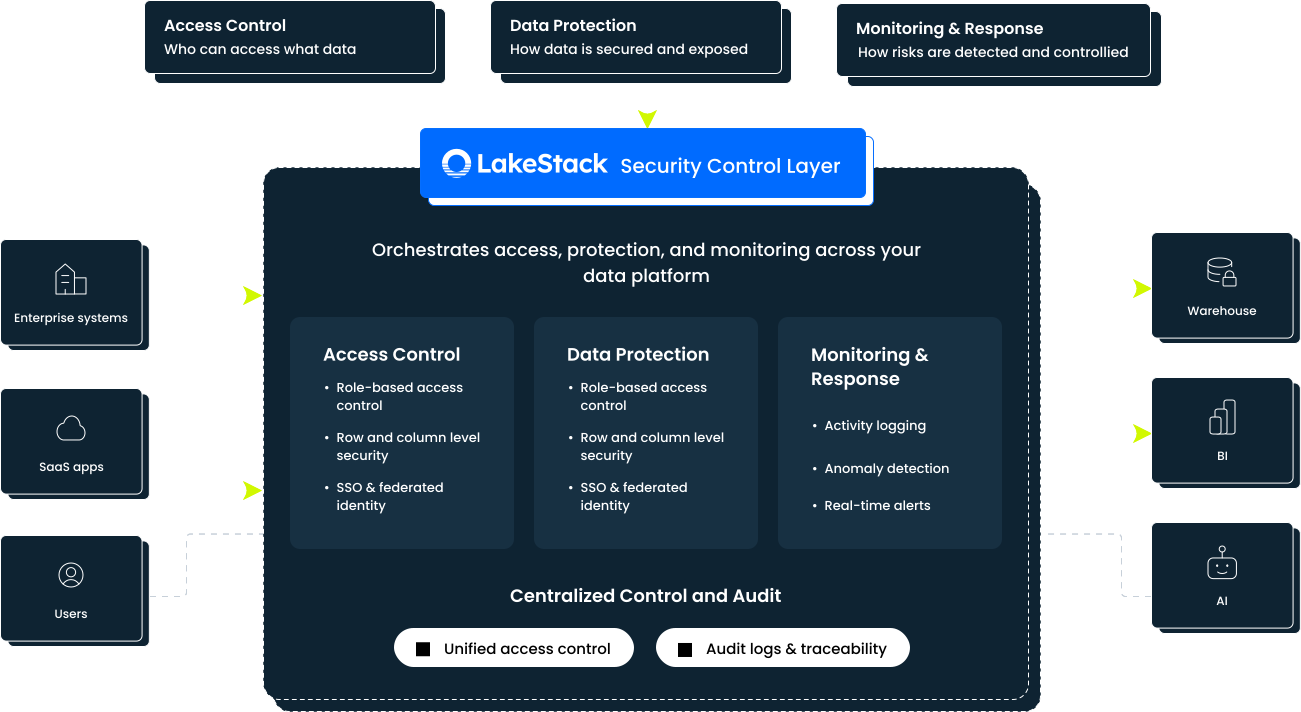
Data access grows faster than control
Governance gaps don’t show up all at once. They compound with every new source, pipeline, and team.

PII, financial records, and regulated data move across systems before controls are applied. Masking, encryption, and classification come too late, increasing exposure at every step.

Permissions accumulate over time without clear ownership or visibility. Teams lose track of who can access what until an audit or incident forces the answer.

When data moves without traceability, issues surface too late. By the time a number looks wrong, finding the source takes days instead of minutes.
Built into the foundation, not added later
Governance in LakeStack is not a separate layer. It is applied at ingestion and enforced across every stage automatically.

Organize data into domain-specific spaces where each team operates within clear boundaries. Access is controlled at the dataset, column, and row levels based on roles and context. Teams only see what they are meant to, while still enabling controlled sharing across spaces. Governance aligns with how your organization actually works.

Every dataset is indexed, classified, and searchable from the moment it enters the foundation. Teams understand what data exists, where it comes from, and how it should be used. This reduces confusion and removes reliance on documentation. Data becomes easier to trust and easier to use.

Access, masking, and compliance rules are enforced continuously as data moves through the foundation. Policies are not manually applied or recreated across tools. Every interaction follows the same rules automatically. Governance stays consistent without operational overhead.

Every field is traceable from source to consumption across transformations and use cases. All activity is logged, making audits straightforward and reliable. When something changes, you can see what is impacted before it breaks downstream systems. Nothing depends on manual tracking.
Governance is embedded at every stage of the data lifecycle
LakeStack does not reconstruct governance after pipelines are built. It applies control, classification, and traceability as data moves through the foundation.
What governance looks like in your sector
Compliance requirements vary. The underlying governance approach stays consistent, applied from ingestion through usage.

Patient and clinical data are classified and protected at ingestion, with controlled access across systems and complete audit trails ready for regulatory review.

User and product data are governed with consent, residency, and masking enforced before it reaches analytics or AI systems.

Operational and plant data is governed across systems, ensuring traceability, controlled access, and consistent reporting across environments.

Shipment and partner data are controlled across regions, with policies applied to access, retention, and cross-border movement.
Govern once. Trust everywhere.
When it is applied at the foundation, every downstream use inherits the same controls, definitions, and trust.

Finance, operations, and product teams all work from the same governed data: no conflicting numbers, no parallel datasets.

New dashboards, applications, and AI models use data that is already controlled and ready. No delays for access fixes or compliance checks.

Governance is not a separate workflow to manage. Policies are enforced automatically, reducing manual reviews and rework.
As data grows across sources and teams, control remains intact. You do not trade speed for compliance as the business expands.
.png)


Frequently asked questions
LakeStack supports domain-level isolation, so each team or business unit operates within its own governed data space. Access, policies, and visibility are scoped independently, even when the underlying data is shared. This prevents accidental exposure while still allowing controlled cross-domain access when needed. Teams collaborate without compromising boundaries or control.
Policy changes are applied centrally and take effect immediately across all downstream usage. You do not need to update individual dashboards, pipelines, or applications. This ensures that new rules are enforced consistently without breaking existing workflows. Governance evolves without creating rework or inconsistencies.
Governance is applied as data moves, not after it lands, so the same controls extend to real-time and batch data alike. Policies such as masking, access control, and classification are enforced continuously within the data flow. This means streaming data does not bypass governance or introduce blind spots. Real-time use cases remain secure and compliant by default.
Yes, the same governed datasets are used across analytics, applications, and operational systems. Policies are enforced consistently, regardless of how or where the data is consumed. This avoids duplication and ensures that operational tools and dashboards reflect the same controlled data. Governance does not fragment across different use cases.
Governance is embedded into how data is ingested and transformed, removing the need for manual checks and approvals. Policies are enforced automatically, so teams do not rely on documentation or tribal knowledge to stay compliant. This reduces human error and ensures consistency across all data interactions. Teams focus on using data, not policing it.
Your data should not rely on afterthought governance
LakeStack applies security and governance from the start, so your teams move faster with data that is already trusted, controlled, and ready for use.


