


.png)



Every enterprise leader has sat in a budget review and watched a number nobody can fully explain. Marketing has one customer count. Finance has another. The AI pilot the board approved last quarter has stalled because nobody can agree which dataset is correct. This is not a data problem. It is an architecture problem, and it usually traces back to one of two root causes: an ungoverned pile of SaaS tools, or a data stack that was never built with a single source of truth in mind.
This article gives you a direct way to diagnose which one you are dealing with, what separates a modern data stack from SaaS sprawl, and a step-by-step framework for moving from one to the other without a multi-year rebuild. If you want the deeper diagnostic first, our free guide on fixing tool sprawl covers the same territory in more depth, including a scored self-audit you can run today.
What You Will Learn
- The concrete difference between a modern data stack and SaaS sprawl
- The financial and operational cost of unmanaged application growth
- A diagnostic checklist to assess your own environment
- A phased framework for consolidation
- Common mistakes enterprises make when they try to fix this
What Is A Modern Data Stack
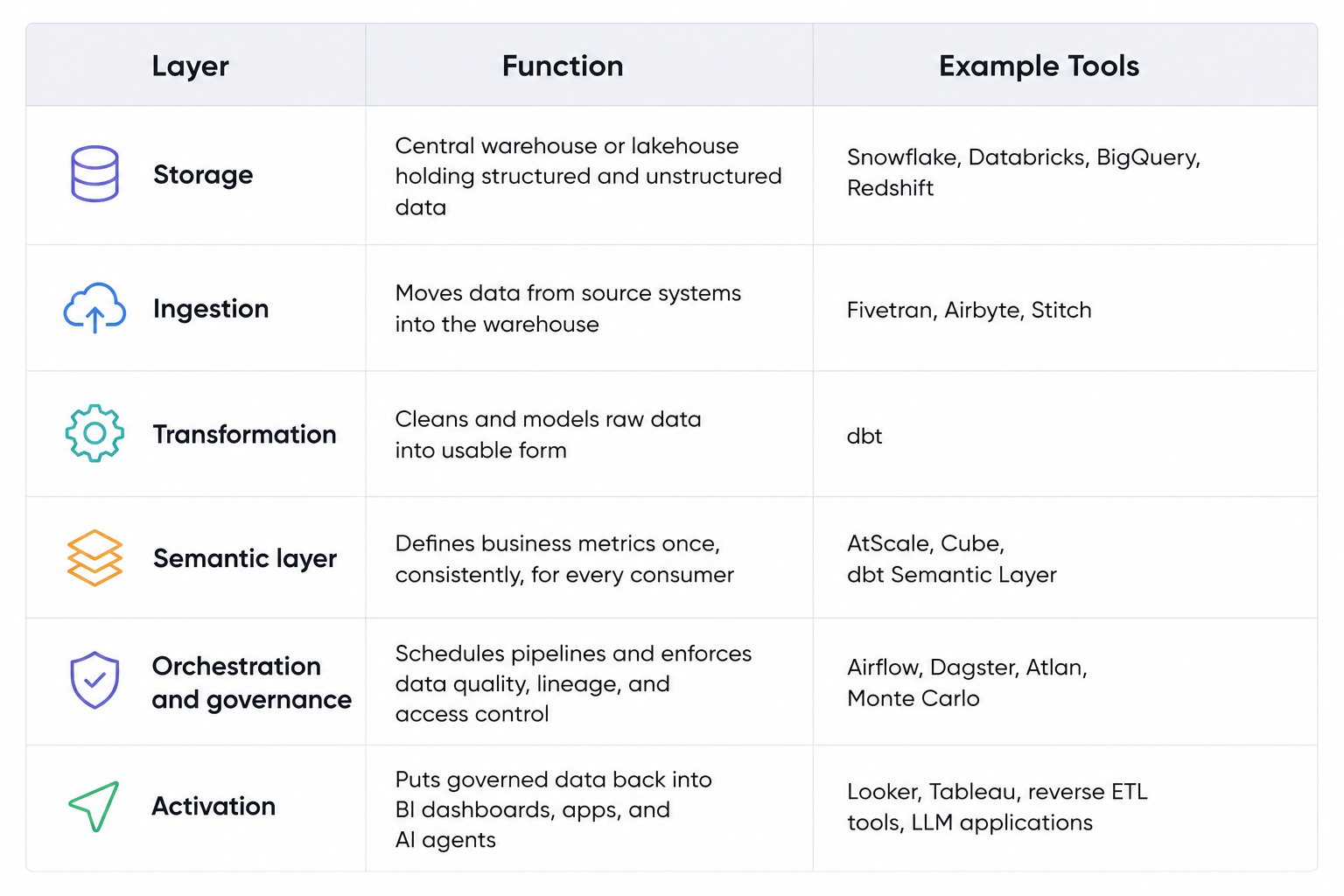
A modern data stack is a cloud-native, modular set of tools that ingest, store, transform, govern, and deliver data from a single, trusted foundation, typically a cloud data warehouse or lakehouse (Snowflake, Databricks, Google BigQuery, or Amazon Redshift). Around that core sit ingestion connectors, a transformation layer, a semantic layer that defines what each business metric actually means, orchestration for pipeline reliability, and business intelligence or AI applications on top.
The defining trait is not the vendor list. It is that every layer answers to one governed foundation instead of operating as an island. Teams that have outgrown a fragmented setup often feel this first in reporting, which is exactly what we cover in what actually breaks in traditional data lakes and warehouses.
Here is what each layer actually does, and which tools typically sit inside it.
The Six Layers Of A Modern Data Stack
What Is SaaS Sprawl
SaaS sprawl is the uncontrolled accumulation of software subscriptions across a business, purchased department by department, often on credit cards, with no central inventory, no shared data model, and no single team accountable for the whole. Each tool solves a local problem well. Collectively, they fragment the business's view of itself.
The scale of this problem in 2026 is larger than most leadership teams assume, and estimates vary sharply depending on whether shadow IT gets counted. IT departments typically manage only a small fraction of an organization's total SaaS footprint, meaning business units and individual employees are purchasing and running most of it without central visibility.
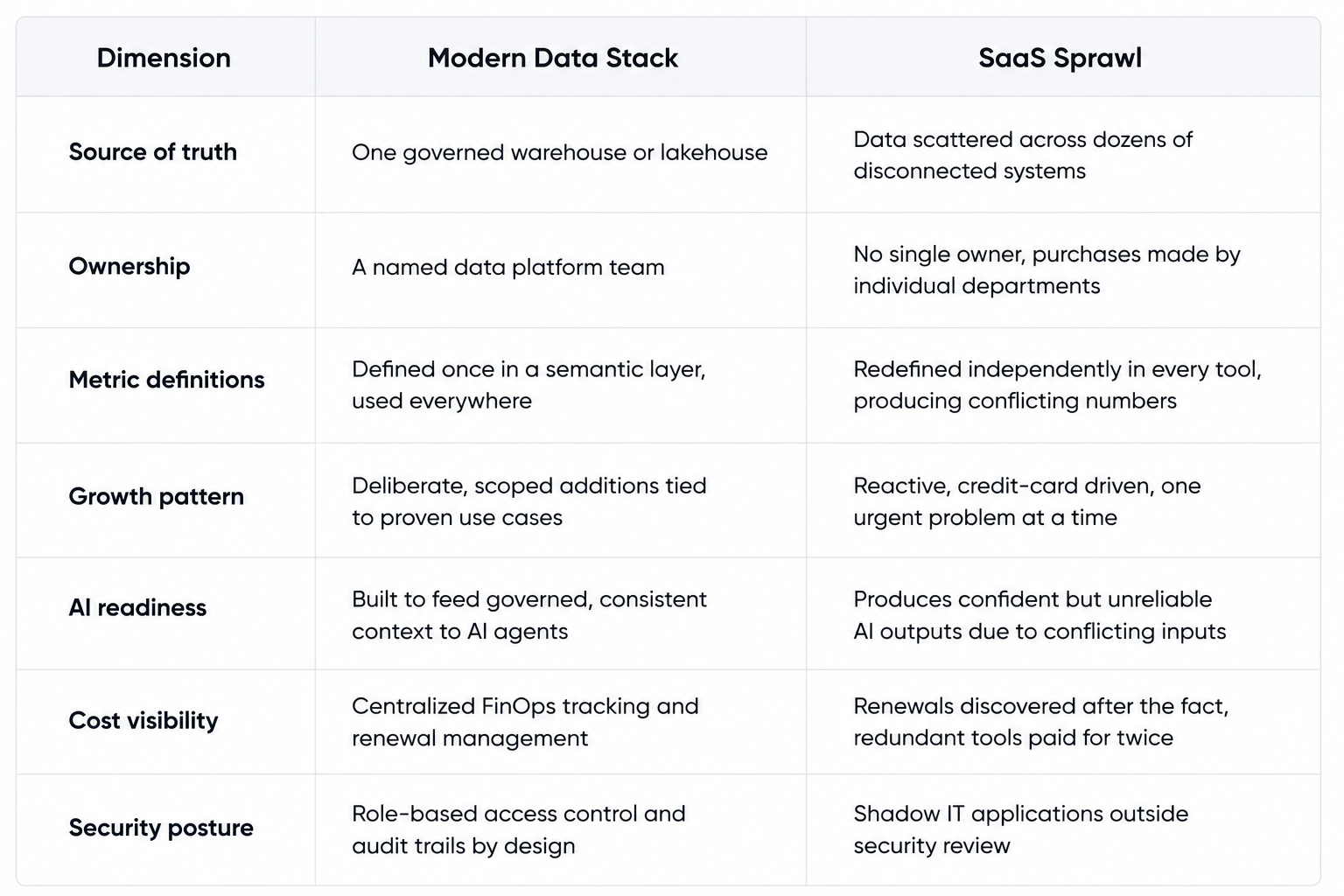
Modern Data Stack Vs SaaS Sprawl - The Real Difference
Side by side, the two approaches look like this.
Why This Distinction Matters Right Now
Three forces are converging in 2026 that make this an urgent, not academic, question.
AI has zero tolerance for ungoverned data. An AI agent querying a poorly governed environment will generate a confident, well-formatted answer built on stale data and conflicting metric definitions. The output looks correct. It is not reliable, and at enterprise scale, that unreliability compounds into systematic bad decisions rather than isolated errors. AI readiness has become a data architecture requirement, not a feature layered on afterward. This is the same gap we walk through in how to move from data chaos to AI-ready insights, including the four steps that tend to matter most.
The financial exposure is material. SaaS spend keeps climbing even where application counts have started to level off, and renewals now land often enough that tracking them casually is no longer realistic. Separate research estimates the average enterprise wastes approximately $18 million a year on unused or underutilized licenses, with roughly half of purchased SaaS licenses going unused entirely (Source: BetterCloud, 2026 SaaS Statistics; Speakwise, 2026).
Consolidation now beats expansion economically. Analyst data cited in enterprise SaaS research shows that consolidated, unified data platforms can cut total cost of ownership by up to 36% compared to fragmented best-of-breed stacks, with implementation timelines finishing meaningfully faster (Source: Gartner SaaS Spending Analysis 2026, cited in Torii SaaS Benchmark Report). The economics have flipped. Adding another point solution is no longer the path of least resistance.
Diagnostic Checklist - Does Your Business Have SaaS Sprawl
Answer honestly. If you check more than four of these, you are looking at sprawl, not a stack.
- No single team can produce a complete inventory of every application in use
- Two departments report different figures for the same core metric (revenue, active customers, churn)
- New tools get purchased on a credit card without IT or security review
- Nobody owns SaaS renewal timing, so cancellations and re-negotiations happen reactively
- Data engineers spend more time firefighting broken pipelines than building new capability
- An AI or analytics initiative has stalled because the underlying data could not be trusted
- Employees maintain personal workarounds (spreadsheets, exports) because the "official" system is unreliable
- You genuinely do not know your total SaaS spend without a multi-week audit
This checklist is a fast gut check. If you want the fuller version, a scored 10-question self-audit that tells you exactly where you land, green, yellow, or red, download our free guide on fixing data chaos.
Step-By-Step Framework - Moving From Sprawl To A Stack
Here is the sequence that tends to hold up in practice, in the order it should actually happen.
Step 1 - Build Visibility
Deploy an inventory pass across finance records, SSO logs, and expense reports to surface every application in active use, not just the ones IT approved. Most organizations discover they are running well beyond their official records once shadow IT is counted properly.
Step 2 - Classify Every Application
Sort every application into three buckets: critical (ERP, CRM, core finance systems), supporting (department tools that speed up specific workflows but are replaceable), and optional. This single exercise usually reveals the redundant tools first, since critical systems rarely overlap but supporting tools frequently do.
Step 3 - Consolidate The Data Layer First
Resist the instinct to cancel licenses before you fix the underlying data problem. Stand up a central warehouse or lakehouse, connect your highest-value sources, and build a governed semantic layer so every team is calculating metrics the same way. This is the step that actually stops the conflicting-dashboard problem, and it is where automating the cleanup work matters most. We cover the mechanics of that in how automated data cleansing and tagging actually works, which is worth a read before you scope this step.
Step 4 - Govern The Renewal Cycle
Put one team in charge of tracking every SaaS renewal, with a standing quarterly review of usage against cost. This alone typically recovers a meaningful share of SaaS spend in the first quarter without touching a single line of code.
Step 5 - Build AI On The Governed Foundation
Once metric definitions are centralized, AI agents and copilots can be layered on top with confidence, because they are drawing from one consistent source rather than reconciling conflicting inputs on the fly. This is also the point where most teams start asking whether their data can actually support generative AI use cases, a question we answer directly in what enterprises miss when trying to fuel GenAI with their data.
Common Mistakes Enterprises Make
- Cutting licenses before fixing governance. Slash-and-burn cost cutting delivers a quick win, then a second-quarter backlash when teams quietly re-procure tools they actually needed, often at worse pricing because negotiating leverage was lost.
- Treating the warehouse as the whole solution. A cloud data warehouse without a semantic layer still lets every team define "active customer" differently. The tools were right. The governance discipline was missing.
- Letting business units keep unrestricted purchasing power. Without a review gate, sprawl regenerates within a year of a successful cleanup.
- Building AI pilots on ungoverned data to move fast. This produces demos that work and production systems that do not, because the underlying data was never trustworthy at scale.
- Underestimating shadow IT. Official inventories miss the majority of tools in most organizations, and the governance risk that comes with them is easy to miss until an audit forces the issue, something we unpack further in how governance risks quietly threaten AI project success.
Best Practices
- Assign one accountable owner for the entire data platform, not a committee
- Scope a modern data stack rollout to four to six core tools before adding more
- Define metrics once, in a semantic layer, before building new dashboards
- Run a quarterly SaaS and data source audit as a standing process, not a one-time project
- Treat AI readiness as a data governance requirement from day one, not a downstream feature
Real-World Pattern
A mid-market manufacturer with data scattered across a legacy ERP, a dozen departmental SaaS tools, and three separate reporting spreadsheets could not get a single trusted view of inventory across plants. After consolidating onto a governed lakehouse foundation with a defined semantic layer for core operational metrics, the business cut redundant data sources by more than half and moved from a 30-day pipeline build cycle to a matter of days. This is a consistent pattern across enterprises that replace fragmented tooling with a single, catalog-governed foundation: fix the source once, and every tool built on top of it becomes more reliable, not less.
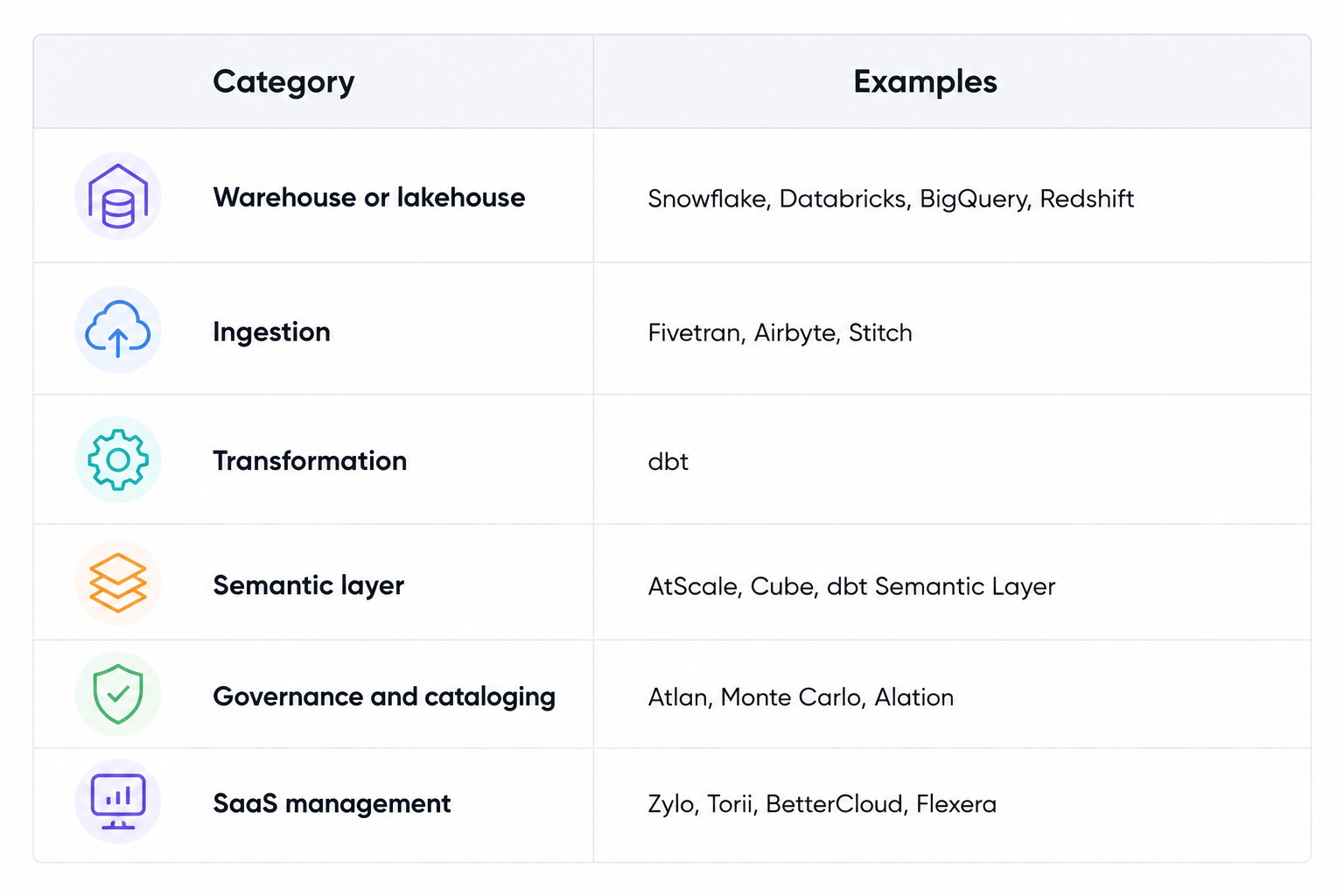
Tools Referenced In This Guide
These are the categories of tools that typically make up each layer, along with a few common names in each.
What CIOs And CDOs Actually Want To Know
What is the difference between a modern data stack and SaaS sprawl? A modern data stack is governed, with one source of truth and a named owner. SaaS sprawl is ungoverned application growth with no central inventory or shared metric definitions, even when built on similar underlying tools.
How many SaaS applications does the average company use in 2026? Estimates range widely, roughly from a hundred to well over three hundred, depending on whether the count includes only IT-managed subscriptions or every application employees actually log into, including shadow IT (Source: Zylo, 2026 SaaS Management Index; SellersCommerce, 2026).
Why do different data sources report such different SaaS counts? Methodology. Some research counts only paid, IT-managed subscriptions. Others count every unique login or OAuth connection, which captures shadow IT. Both figures are accurate measurements of different things.
What is shadow IT and why does it matter? Shadow IT refers to applications employees adopt without formal approval from IT or security teams. It accounts for a large share of enterprise application usage and creates both financial waste and security exposure, since unmanaged tools skip standard review processes.
How much does SaaS sprawl cost a typical enterprise? Research estimates the average enterprise wastes approximately $18 million a year on unused or underutilized SaaS licenses, with roughly half of all purchased licenses going unused.
Is a data warehouse the same thing as a modern data stack? No. A warehouse is one component. A modern data stack also includes ingestion, transformation, a semantic layer, orchestration, governance, and activation working together around that warehouse.
What is a data lakehouse? A data lakehouse combines the low-cost, flexible storage of a data lake with the structured query and governance capabilities of a data warehouse, supporting structured, semi-structured, and unstructured data in one environment.
Why does AI readiness depend on data governance? AI agents generate answers from whatever data they are given. If metric definitions conflict across systems, the AI produces confident but incorrect output. Governance is what makes AI output trustworthy at scale, not just fast.
What is the first step to fixing SaaS sprawl? Visibility. Build a true inventory of every application in use, including shadow IT, before making any cuts or purchasing decisions.
Should we cancel unused SaaS licenses immediately? Not without classification first. Sort applications into critical, supporting, and optional categories, since cutting critical tools too aggressively often forces expensive re-procurement within a year.
How long does it take to build a modern data stack? Most organizations can reach a working MVP in three to six months by scoping the initial rollout to four to six core tools tied to a small number of proven use cases, then expanding.
What is a semantic layer and why does it matter? A semantic layer defines business metrics once, centrally, so every dashboard, report, and AI application calculates figures like revenue or active customers the same way, eliminating conflicting numbers between teams.
Can a company run a modern data stack and still have SaaS sprawl? Yes. A well-governed data platform can coexist with sprawling, ungoverned operational SaaS tools outside the data team's control. The two problems require separate, coordinated fixes.
What roles should own a modern data stack initiative? A single accountable data platform owner, typically reporting into the CIO or CDO, supported by data engineering, governance, and a FinOps function tracking cost and renewals.
Is SaaS sprawl shrinking or growing in 2026? Signals are mixed. Some datasets show application counts stabilizing or slightly declining as enterprises consolidate, while total SaaS spend continues rising due to AI feature bundling and price increases.
Conclusion
The question is not whether your business runs a lot of software. Every enterprise does. The question is whether that software answers to one governed source of truth or grew into an ungoverned pile one department purchase at a time. Get the diagnosis right, and the fix is a phased, achievable project. Get it wrong, and every AI initiative, board report, and cost-cutting exercise built on top of it inherits the same unreliability.
Next step: if the checklist above raised more flags than you expected, start with visibility, not vendor selection. A structured data discovery workshop can map your current environment and show exactly where sprawl is costing you before you commit to a rebuild.
For a self-guided starting point, our free guide on fixing tool sprawl walks through the same diagnostic in more depth, built specifically for CTOs, CDOs, and heads of data.