Transformations

Transform your data into analytics and AI-ready datasets

LakeStack standardizes, cleans, and structures your data automatically, so your teams always work with reliable, ready-to-use datasets.

See transformation in action
Business ROI

Trusted datasets drive better decisions, and better returns

Data preparation isn't a back-office function; it's a lever for revenue. When your data foundation is solid, every downstream investment compounds.

80%
Reduction in manual data preparation time
70%
Faster operational insights across teams
More data pipelines delivered per quarter
Why LakeStack

Intelligent data transformation with LakeStack

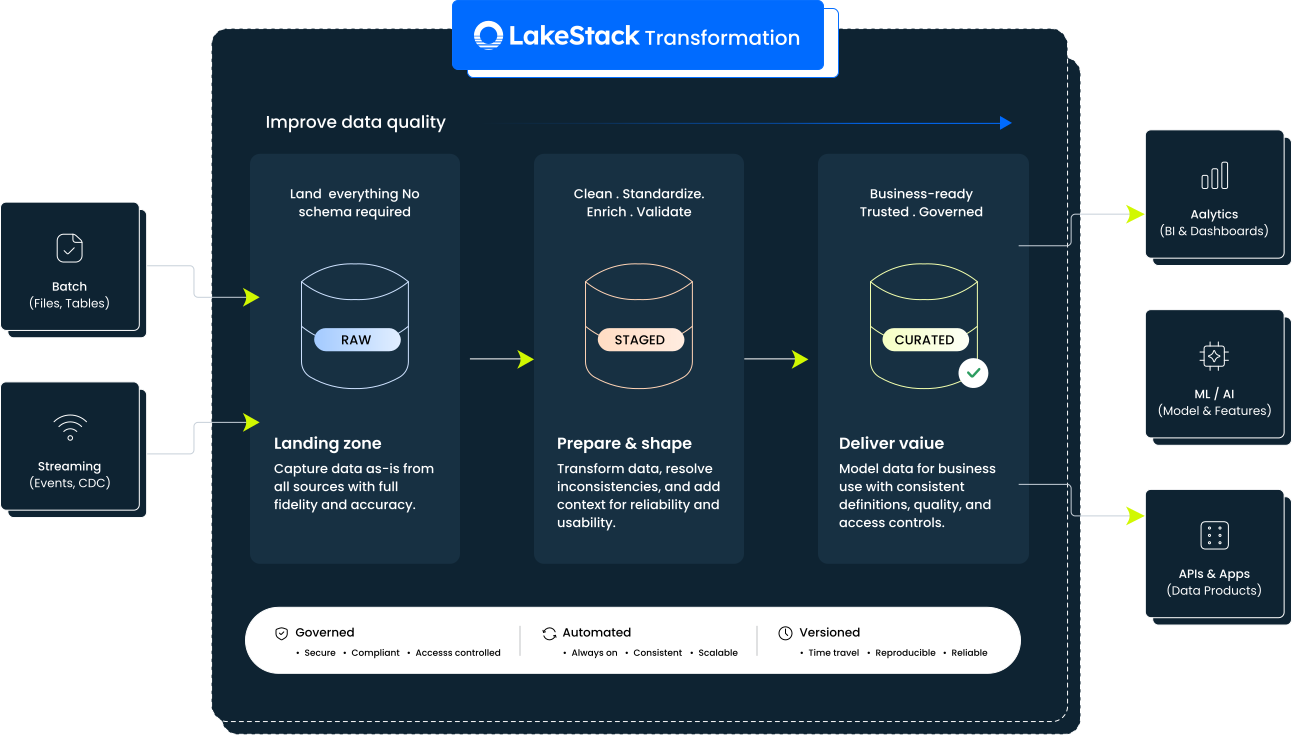
LakeStack processes raw data from any source and delivers consistent, analytics-ready Apache Iceberg tables on S3, with ACID transactions, schema evolution, lineage, and observability.

Adaptive schema handling & intelligent mapping
Automatically detects schema changes and drift, then intelligently maps incoming data to your standardized target models using semantic understanding and dynamic rules.
Fewer pipeline failures from schema changes
Automated cleansing, standardization, & quality
Combines context-aware standardization, deduplication, normalization, validation rules, and real-time anomaly detection into a single pass, ensuring only clean, consistent data proceeds.
Less manual data preparation effort
Rule-driven enrichment & business logic
Joins datasets across sources, computes derived fields, and adds business context (such as hierarchies, lookups, or calculated metrics) based on centrally defined models and rules.
Faster time to insights
Unified real-time, batch & streaming processing
Processes data in batch, CDC, or streaming mode within one engine, eliminating the need for separate codebases or tools.
Real-time data availability across systems
Workflow control

Orchestrate every data workflow from a single control layer

Ensure every transformation runs in the right sequence, at the right time, with full visibility and control across all workflows.

Smart scheduling
Define when each pipeline should run based on business needs. Whether it’s frequent refreshes for operational dashboards or scheduled batch jobs for reporting, workflows execute automatically at the right cadence.
Event-driven execution
Trigger pipelines instantly when new data arrives or a prior step completes. This ensures minimal latency between data ingestion and downstream availability.
End-to-end monitoring
Track every workflow execution with detailed logs, status updates, and performance insights. Gain full visibility into pipeline health across all stages.
Proactive alerts
Detect failures or bottlenecks in real time and receive immediate alerts so issues can be resolved before they impact downstream reporting or systems.
Customer story

Proven business impact

Discover how leading organizations use LakeStack to transform fragmented data sources into governed, high-impact business assets.

About Client
AFG.tech operates a multi-location dealership platform, with core data spread across CRM, workshop, and invoicing systems.
As the platform scaled, data remained siloed and inconsistently structured. Reporting depended on manual effort and custom pipelines, making it difficult to get a reliable, real-time view of operations across dealerships.
9-12
months of engineering effort avoided.
80%
reduction in ingestion and reporting workload.
AFG.tech replaced fragmented, pipeline-heavy data workflows with a unified, governed lakehouse, enabling real-time access to consistent, query-ready data across all dealerships.
View case study
About Client
Kior Healthcare operates across multiple clinical systems, with data spread across lab systems, ERP, bookings, imaging, and unstructured sources like PDFs and clinician notes.
As data volume and formats grew, teams relied on manual data preparation and file handling, making it difficult to access timely, reliable information for both clinical and operational decisions.
80%
reduction in manual data prep and file processing
70%
faster clinician and operational visibility
KIOR Healthcare logo with stylized letters and circular design elements in light blue.
Kior Healthcare replaced fragmented, file-heavy data workflows with a unified, governed lakehouse, bringing structured and unstructured clinical data into a single, query-ready foundation.
View case study
Use cases

What you can achieve

AI-ready data that is structured, consistent, and context-rich enough to directly power modern AI systems and LLM workflows without reprocessing or manual reshaping.

01
Train domain-specific LLMs

Use structured internal data to fine-tune or ground models on your business context, products, operations, and domain knowledge.

02
Build retrieval-augmented generation (RAG) systems

Enable accurate, real-time RAG pipelines where LLMs retrieve information from transformed datasets instead of relying on static or outdated training data.

03
Enable natural language querying across data

Allow business users to interact with data in plain English, powered by consistent schemas and well-structured underlying datasets.

04
Power AI-driven copilots and assistants

Build internal copilots for sales, operations, support, or analytics that deliver contextual responses grounded in unified, trusted data.

05
Improve model accuracy and reliability (TRiSM)

High-quality, standardized datasets reduce noise, minimize hallucinations, and improve the precision of AI-generated outputs.

06
Automate decision-making workflows

Feed real-time transformed data into AI systems that trigger recommendations, alerts, and automated actions across business processes.

07
Unify structured and semi-structured data for AI

Combine transactional, event, log, and document data into a unified layer that enables broader contextual reasoning across AI systems.

08
Enable cross-functional data products

Turn transformed datasets into reusable, governed data products that can be consumed across teams, tools, and applications.

Frequently asked questions

How does LakeStack support data preparation for analytics and AI?

LakeStack centralizes transformation logic, so data is cleansed, modeled, and governed once, then reused everywhere. Teams stop rebuilding pipelines and start trusting the outputs, whether those outputs feed a dashboard, a report, or a machine learning model.

How is LakeStack different from traditional transformation tools?

Traditional tools treat transformation as a separate step, disconnected from ingestion and activation. LakeStack unifies the entire pipeline: ingest, transform, govern, activate. You manage logic in one place, track lineage end-to-end, and scale without fragmentation.

Can we reuse transformation logic across teams?

Yes, and that's a core architectural principle. Once defined, transformation logic is centralized and reusable across datasets, use cases, and teams. Finance and Operations work from identical definitions. No duplication. No reconciliation meetings.

How does LakeStack handle large-scale transformations?

LakeStack supports both batch and incremental processing. Incremental transformations only process what's changed since the last run, dramatically reducing compute consumption and latency, especially important as data volumes scale.

Can transformations support real-time use cases?

Yes. Near-real-time and incremental transformations power live dashboards, operational analytics, and AI models that require up-to-date data. The platform is designed for businesses that can't afford to wait for a nightly job.

Do we need to manage transformation pipelines manually?

No. LakeStack automates orchestration, dependency resolution, and execution sequencing. Your engineers define the logic, the platform handles the rest, reliably and at scale, without custom scheduler code or brittle DAGs.

See LakeStack in action with your data

Get a clear view of how your current data setup can be structured, standardized, and automated without pipeline overhead. We’ll review your existing architecture and show what changes with LakeStack.