


AI is easy when the data is ready.
LakeStack builds the governed data foundation that makes intelligence usable. Your dashboards reflect what is happening now, your models run on trusted data, and your teams get answers without waiting.
The reason your AI pilot hasn’t shipped
The model is rarely the issue and the use case is usually clear, but what breaks is the data underneath. AI isn’t the hard part, getting the foundation right is.
Customer, product, and operational data live in separate systems with no consistent structure. Teams spend time stitching it together instead of using it.
Revenue, active users, and other key metrics are defined differently across systems. Outputs don’t align, so no one fully trusts the results.
Teams don’t know which data they can use or which source is authoritative. Every new use case slows down due to uncertainty.
Schema changes and upstream updates break pipelines. By the time data is usable, it’s already outdated.
A single foundation for decisions across analytics and AI
When your data is unified, governed, and current, intelligence stops being a separate effort. It becomes part of how your teams operate every day.
Your teams see what is happening as it happens, not hours or days later. Operations respond to issues early, and leadership works from numbers that do not need reconciliation. Everyone moves faster because the data is already aligned.
Models run on consistent, governed data that stays up to date. They do not break with schema changes or missing fields. You move from isolated experiments to systems that actually support decisions in production.
Teams ask questions in plain language and get answers they can trust. No dependency on analysts, no conflicting numbers across tools. Data becomes accessible without losing control or accuracy.
Intelligence only works when the foundation is right

Most AI and analytics systems fail because they sit on top of fragmented, inconsistent data. Here, every output is built on data that is already unified, governed, and reliable. You are not fixing data downstream or working around gaps. The foundation is already correct.

Analytics, models, and applications operate on the same data layer, not separate pipelines. This removes duplication, reduces inconsistencies, and keeps every output aligned. Teams do not have to reconcile numbers across systems. Everything works from the same source of truth.

Data is not just available; it is structured with meaning, relationships, and definitions intact. Systems understand how data connects, not just what it contains. This leads to more accurate outputs, fewer errors, and decisions that reflect real business context.

Intelligence reflects what is happening now, not what happened yesterday. Pipelines keep data continuously updated, so dashboards, models, and decisions stay relevant. You avoid lag, stale insights, and delayed reactions. Teams operate with current information by default.
What becomes possible when the data is ready
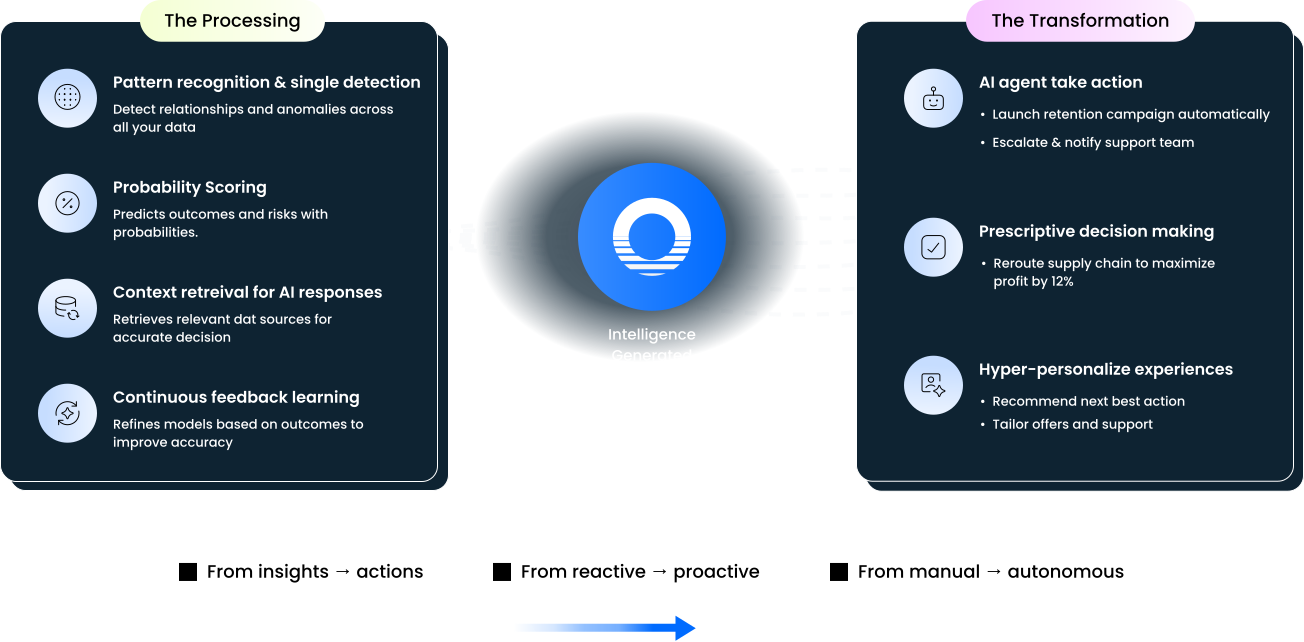
When data is unified, governed, and current, intelligence becomes part of how your teams work, not a separate system.
Teams ask questions in plain language and get answers grounded in consistent, governed data. No dependency on analysts or manual queries.
Structured and unstructured data are accessible from one place. Teams find what they need without switching systems or guessing sources.
Models run on current, reliable data and support real decisions, not isolated experiments. Outputs reflect what is happening in the business.
Systems act on governed data directly, triggering actions and workflows without manual intervention or disconnected pipelines.
Proven business impact

Discover how leading organizations use LakeStack to transform fragmented data sources into governed, high-impact business assets.



How intelligence shows up in your industry
Every industry runs on different data, but the outcome is the same. When data is unified, governed, and current, decisions become faster, clearer, and more reliable.

Patient, billing, and clinical data come together into a single, governed view. Dashboards reflect what is happening now, and risk models run on consistent, up-to-date data. Every decision is based on complete context, not partial information.
- Unified patient view across systems
- Readmission risk prediction and scoring
- Population health and care optimization

Product usage, customer data, and revenue signals are unified into a consistent foundation. Teams work from the same metrics across product, marketing, and finance, without conflicting reports. Models and analytics reflect real user behavior, enabling faster and more accurate decisions.
- User behavior analysis across platforms
- Churn prediction and retention insights
- Revenue funnel and cohort analysis

Production, supply chain, and quality data are connected into a single, reliable view. Teams monitor operations in near real time and respond before issues escalate. Analytics and models reflect actual shop floor conditions, not delayed or partial data.
- Real-time production performance monitoring
- Quality tracking and defect analysis
- Demand forecasting and supply planning

Shipment, fleet, and partner data are unified across regions and systems. Teams track movement in real time, identify delays early, and act before disruptions impact customers. Decisions are based on a complete, current view of the network.
- End-to-end shipment tracking visibility
- Delay prediction and exception management
- Route optimization and fleet utilization

.png)
.png)
Frequently asked questions
Most teams find out too late, when pilots stall, or outputs cannot be trusted. The signs are consistent: fragmented data, unclear definitions, delayed reporting, and limited access across teams. If decisions depend on manual fixes or reconciliation, the foundation is not ready. The goal is not more tooling, but data that can be used directly across analytics and AI.
No. Your current tools remain in place, but they start working as intended. The difference is that every tool now runs on consistent, governed, and current data. This removes conflicting outputs and repeated pipeline work across teams. You get more value from what you already use without replacing it.
Most teams spend months stuck in pilots because they are fixing data, not building intelligence. With LakeStack, once data is unified and governed, use cases move to production in days, not months. The delay is removed because pipelines, definitions, and access are already in place. New use cases build on the same foundation instead of starting from scratch.
Decisions are made on current, consistent data instead of delayed or conflicting reports. Teams no longer wait for data preparation or validation before acting. This reduces back-and-forth between business and data teams. Intelligence becomes part of daily workflows, not a separate step.
Data is continuously updated, governed, and tracked as it moves through the system. Changes in source data do not break downstream outputs or create inconsistencies. Definitions and policies remain consistent across all use cases. This ensures that dashboards, models, and decisions stay accurate over time.
Your AI doesn’t need another pilot. It needs ready data.
If your models are ready but your data is still fragmented, delayed, or unclear, the problem isn’t the AI. It’s the foundation underneath it. LakeStack gives your teams data they can actually use, so analytics and AI move from backlog to production without another rebuild.
See if your data is AI-ready


