

.png)



Your data warehouse knows everything. The problem is, your business tools do not.
Every quarter, businesses invest heavily in centralizing data into Snowflake, BigQuery, or Databricks. Analytics teams build gold-standard models. Executives receive polished dashboards. And yet, the sales rep staring at a Salesforce record sees yesterday's stale lead score. The marketing team fires a campaign at customers who converted two hours ago. The support agent misses a churn signal that the warehouse caught last week.
This gap between insight and action is not a people problem. It is an architecture problem. And reverse ETL is the discipline that closes it.
This guide is written for business leaders and decision-makers who understand the value of their data investments but want to ensure those investments flow all the way to the operational front lines, not just to dashboards. Whether you are evaluating tools, rethinking your data stack, or preparing a case for your leadership team, you will find a clear, structured answer to the question: what is reverse ETL, and does your organization actually need it?
What is reverse ETL
To understand reverse ETL, it helps to understand the direction of traditional data pipelines first.
Traditional ETL (Extract, Transform, Load) moves data from operational systems, think CRMs, ERPs, payment processors, into a centralized data warehouse. The goal is consolidation. You pull from many sources and land the data in one place for analysis.
Reverse ETL flips this direction entirely. It takes the curated, transformed, and trusted data sitting inside your warehouse and pushes it back out to the business tools where teams actually work. Sales platforms. Marketing automation. Customer success software. Product analytics. Finance systems.
IN PLAIN TERMS
Reverse ETL is the operational layer of the modern data stack. It ensures that the insights your data team builds are not confined to dashboards, but live inside the tools that drive revenue, retention, and growth.
Think of it this way: a traditional ETL pipeline makes your warehouse smarter. A reverse ETL pipeline makes your entire business smarter. It operationalizes your data.
This distinction matters enormously for business leaders. A company with excellent warehouse infrastructure but no reverse ETL is like an elite research department whose findings never leave the building. Reverse ETL is the translation layer between analytics and action.
22.3% CAGR
Projected growth rate of the global reverse ETL market from 2024 to 2033, reaching $4.12 billion (Source: MarketIntelo, 2025)
ETL vs reverse ETL: understanding the directional shift
The naming convention can be misleading. Reverse ETL is not simply ETL running backwards in terms of technology. The business intent is fundamentally different.
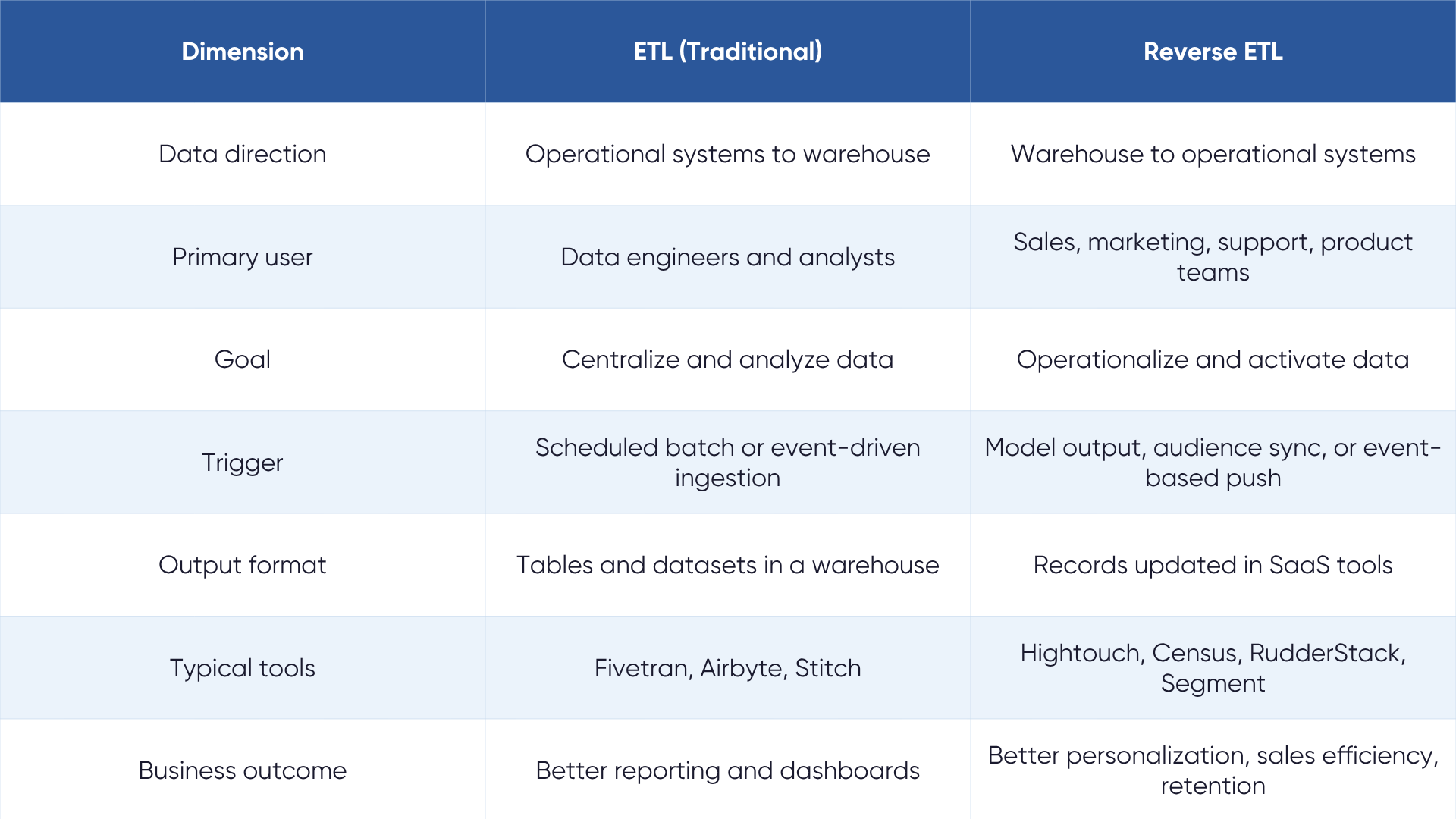
A useful mental model: ETL feeds the brain of your organization. Reverse ETL feeds the hands and mouth. Both are necessary. Without ETL, you have no trusted data to activate. Without reverse ETL, your trusted data stays locked behind a SQL interface that most business users will never touch.
For decision-makers, the strategic question is not whether to choose one over the other. It is recognizing that reverse ETL is a natural next step once your data warehouse reaches maturity. Most organizations that have invested 12 to 24 months in warehouse infrastructure are already reverse ETL-ready. They simply have not connected the last mile yet.
Understanding how your data moves from source to warehouse is a prerequisite. If your organization is still building that foundation, explore our guide to ETL pipeline architecture and engineering before implementing reverse ETL.
Reverse ETL use cases that drive measurable business value
Reverse ETL earns its place on an infrastructure roadmap when it answers a specific business need. Below are the most impactful use cases observed across industries.
Sales intelligence and CRM enrichment
Your warehouse holds product usage telemetry, contract history, support ticket frequency, and predictive churn scores. Most CRM records do not. Reverse ETL syncs this enriched data directly into Salesforce or HubSpot, so account executives see a 360-degree view of every account without leaving their primary tool.
- Lead scores updated in real time based on product behavior
- Churn risk flags surfaced directly on opportunity records
- Account health dashboards built from warehouse models
Impact: Organizations implementing reverse ETL for sales intelligence report 25 to 45 percent increases in lead conversion rates, with payback periods of 3 to 6 months on the investment. (Source: Integrate.io analysis of Pyne research, 2025)
Marketing audience personalization
Marketing teams typically define audiences inside a tool such as Braze or Marketo. Reverse ETL enables those audiences to be defined in the warehouse, using the full richness of your customer data, then synced to the execution layer. The result is hyper-precise segmentation that cannot be replicated inside a marketing platform alone.
- Suppression lists that prevent messaging recently churned users
- Lookalike audiences built from warehouse-defined behavioral clusters
- Real-time event-triggered campaigns based on product actions
Customer success and proactive retention
Customer success teams using tools like Gainsight or Intercom often work with lagged or incomplete health data. Reverse ETL pushes warehouse-computed health scores, usage drop-offs, and expansion signals directly into these platforms, enabling proactive outreach before issues escalate.
Finance and revenue operations
Billing reconciliation, revenue forecasting, and commission calculations often require data that lives in the warehouse but needs to feed downstream into NetSuite, Stripe, or spreadsheet-based workflows. Reverse ETL automates this handoff, reducing manual work and reconciliation errors.
Product analytics and in-app personalization
Product-led growth companies use reverse ETL to power feature recommendations, onboarding flows, and upgrade prompts based on warehouse-computed behavioral segments. A product team can define a cohort in dbt and have it reflected in their product experience within minutes.
INDUSTRY STAT
Companies using reverse ETL for product-led growth have reported 34 percent monthly recurring revenue growth over 12 months, alongside 25 percent improvement in activation rates. (Source: Integrate.io citing Grand View Research, 2025)
At Lakestack, our data activation and integration services are designed to help organizations identify the highest-value reverse ETL use cases and implement them within existing stack constraints.
Reverse ETL vs CDP: choosing the right activation layer
This is one of the most commonly debated questions in the modern data stack conversation, and rightly so. Customer Data Platforms (CDPs) such as Segment, mParticle, and Tealium were built to unify customer identity and activate data across channels. Reverse ETL tools such as Hightouch and Census were built to activate warehouse data.
The distinction is more nuanced than it appears.
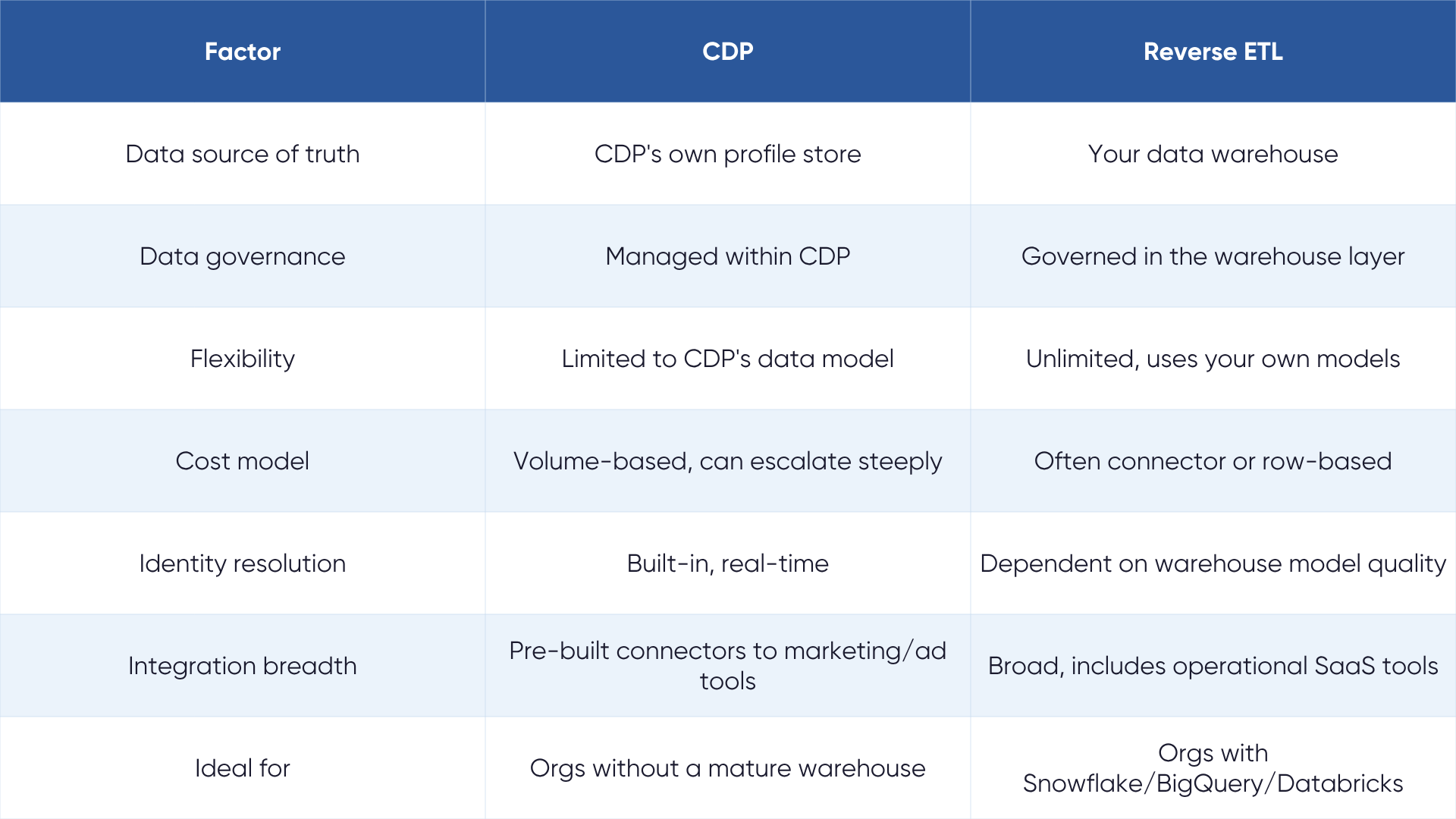
The emerging consensus among data leaders is that reverse ETL and CDPs are not direct competitors for mature organizations. They serve different parts of the journey.
CDPs are excellent for identity stitching and real-time event streaming, particularly when a warehouse is not yet the system of record. Reverse ETL is superior when a warehouse already exists, is trusted, and contains richer, modeled data than any CDP profile store could provide.
A number of forward-thinking companies have moved from pure CDP dependency to a warehouse-first model, using reverse ETL to replace the activation layer of their CDP while retaining the CDP for specific identity resolution or event collection tasks. This hybrid approach captures the best of both architectures.
DECISION FRAMEWORK
The question is not CDP or reverse ETL. It is: where does your cleanest, most trusted data live? If the answer is your warehouse, reverse ETL is the more powerful activation path.
Lakestack's modern data stack consulting practice helps organizations audit their current CDP and warehouse investments to identify where reverse ETL can reduce costs and improve data fidelity.
Segment reverse ETL: when your CDP becomes a destination
Segment is one of the most widely deployed CDPs in the market. Interestingly, Segment itself has embraced reverse ETL as a capability, offering a feature that allows organizations to sync data from connected warehouses back through Segment's destination ecosystem.
This matters for organizations that have standardized on Segment as their event collection and routing layer. Rather than rebuilding destination connections from scratch using a standalone reverse ETL tool, these organizations can leverage Segment's warehouse-to-destination flow. In practice, this works as follows:
- Data flows from operational sources into a warehouse via Segment or direct ingestion
- The warehouse transforms and models this data (often with dbt)
- Segment's reverse ETL capability reads model outputs from the warehouse
- Transformed data is pushed to Segment's 300+ destinations
The benefit is workflow continuity within an existing Segment contract. The limitation is that Segment's reverse ETL feature is tightly coupled to Segment's own destination catalog. If your activation needs extend beyond that catalog, a dedicated reverse ETL tool provides greater flexibility.
For organizations already invested in the Segment ecosystem, this is a practical starting point for reverse ETL without requiring a net-new vendor relationship. For those evaluating from scratch, it is worth comparing Segment's offering against purpose-built tools on connector depth, sync frequency, and observability features.
Dbt reverse ETL: where transformation meets activation
Dbt (data build tool) has become the industry standard for transforming data inside the warehouse. Its declarative SQL-based approach allows data teams to build modular, tested, documented data models that serve as the trusted foundation for analytics.
Reverse ETL and dbt are natural companions. In most mature implementations, the workflow looks like this:
- Raw data lands in the warehouse via ingestion
- dbt transforms raw tables into clean, modeled entities: customer health scores, lead grades, product usage cohorts
- Reverse ETL reads these dbt model outputs and syncs them to operational tools
This pairing is powerful because it preserves data governance throughout the activation journey. The model logic is version-controlled in dbt. The sync configuration is maintained in the reverse ETL tool. Both are auditable, testable, and reproducible.
TECHNICAL INSIGHT
The dbt + reverse ETL combination effectively gives your business teams access to warehouse-grade data quality inside tools like Salesforce, Marketo, or Intercom. This is not possible with most out-of-the-box CDP integrations.
Several reverse ETL vendors, including Hightouch and Census, offer native dbt Cloud integrations that allow you to trigger syncs upon model completion. This eliminates the need for manual orchestration and ensures that the data reaching your operational tools is always based on the most recent warehouse model run.
For data engineering teams, this also simplifies the conversation with business stakeholders. Rather than asking, how do we get this data into Salesforce?, the question becomes simply, which dbt model should we sync?
Lakestack's dbt implementation and optimization services are frequently paired with reverse ETL rollouts to ensure that the data being activated is clean, modeled, and governed before it reaches operational systems.
The market landscape and what it signals to decision-makers
The reverse ETL category emerged visibly around 2021, but it has matured rapidly. Several recent developments signal that this is not a trend but a permanent layer of the enterprise data architecture.
Market size and trajectory
The global reverse ETL market was valued at $0.68 billion in 2024 and is projected to reach $4.12 billion by 2033, growing at a 22.3 percent CAGR. This is against a backdrop of a broader ETL market expanding from $8.85 billion in 2025 to a projected $21.25 billion by 2031 at 15.72 percent CAGR. (Source: MarketIntelo, Mordor Intelligence, 2025)
North America currently accounts for approximately 39 percent of global reverse ETL market share, while Asia-Pacific is projected to exhibit the highest CAGR of 27.1 percent through the forecast period.
Enterprise adoption patterns
Technology and SaaS companies show the highest maturity in reverse ETL adoption, having used it to power product-led growth and customer success workflows for several years. Financial services, healthcare, and retail verticals are currently in rapid adoption phases, driven by demand for real-time personalization and regulatory-grade data accuracy.
Large businesses account for the majority of 2024 revenue in the segment, but SMEs are growing at a faster rate, facilitated by cloud-native tools that require minimal engineering overhead to deploy.
FOR CFOS AND PROCUREMENT LEADERS
The build-vs-buy math is clear: building three basic reverse ETL connectors in-house costs an estimated $24,000 in engineering time. Commercial solutions with unlimited connectors cost under $10,000 annually. (Source: Integrate.io, 2025)
What mature reverse ETL architecture looks like
For organizations ready to move from evaluation to implementation, understanding the architecture is essential. A mature reverse ETL setup typically involves the following components:
1. A trusted data warehouse as the source of truth
Reverse ETL is only as good as the data it reads from. Before activating data to operational tools, organizations need confidence that their warehouse models are accurate, tested, and updated at a frequency that matches business needs. This is typically achieved through dbt with data quality checks and orchestration tools such as Airflow or Prefect.
2. A reverse ETL platform with the right connectors
The choice of platform depends on the destinations you need to reach and the sync frequency required. Leading platforms include Hightouch, Census, and RudderStack (for open-source flexibility). Key evaluation criteria include connector depth, observability, alerting, row-level sync control, and support for incremental vs. full syncs.
3. Data governance and access controls
Because reverse ETL pushes data into tools used by large teams, governance matters. Organizations should define which models are safe to activate, who can configure syncs, and what data fields should be excluded for compliance reasons. GDPR and CCPA considerations apply directly to data that leaves the warehouse and enters customer-facing tools.
4. Observability and alerting
Sync failures silently propagate stale or incomplete data into operational tools, which can have significant downstream consequences such as misguided sales outreach or incorrectly triggered campaigns. Mature reverse ETL implementations include alerting on sync failures, row count anomalies, and latency thresholds.
5. A cross-functional ownership model
Reverse ETL sits at the intersection of data engineering and business operations. Organizations that implement it successfully typically establish a shared ownership model: data engineers maintain the warehouse models, while revenue operations or growth teams own the sync configuration and destination mappings. Without this clarity, syncs drift, models go stale, and the operational value degrades.
If your organization is at the evaluation stage, Lakestack's ROI calculator provides a structured review of your warehouse, transformation, and activation readiness before any tool is selected or deployed.
Common objections from business leaders and how to address them
"We already have a CDP. Why do we need this?"
A CDP provides excellent identity resolution and pre-built marketing integrations. But it cannot match the flexibility, model richness, or governance of a warehouse-first approach. If your CDP's profile data lags behind your warehouse by hours or omits key behavioral signals, reverse ETL fills that gap. Most businesses end up running both, with the CDP handling event collection and reverse ETL handling activation from modeled warehouse data.
"This sounds like an engineering project, not a business project."
The engineering lift is lower than it appears. Modern reverse ETL platforms offer no-code sync configuration for common destinations. The real business case is straightforward: your sales team should not be making decisions on data that is 48 hours old. Your marketing team should not be spending budget on audiences defined inside a tool that cannot see your full customer history. Reverse ETL is an operational efficiency and revenue productivity investment.
"What if our warehouse models are not reliable enough?"
This is the most valid concern and the right question to ask. If your dbt models are untested or your warehouse is treated as a dumping ground rather than a governed asset, you should invest in that foundation first. Activating unreliable data to operational tools compounds the problem rather than solving it. Reverse ETL readiness is a downstream indicator of warehouse maturity.
"How do we measure ROI?"
The clearest ROI indicators are tied to the use cases you activate. For sales intelligence syncs: lead conversion rate improvements and reduction in time spent on manual CRM data entry. For marketing: cost per acquisition reduction through better segmentation and suppression. For customer success: reduction in churn rate among accounts receiving proactive outreach. Most organizations see payback within one to two quarters on their first reverse ETL use case.
Where to start: a decision framework for 2026
If you are evaluating whether reverse ETL belongs on your roadmap, the following questions provide a structured starting point:
- Do you have a cloud data warehouse (Snowflake, BigQuery, Databricks, Redshift) that your team actively uses?
- Does your data team build and maintain transformation models using dbt or equivalent tooling?
- Are your business teams making decisions in operational tools (CRM, marketing, support, product) that do not reflect the data richness in your warehouse?
- Are there manual data exports or CSV uploads being used to move data between the warehouse and business tools?
- Do you have use cases where stale data in a business tool has caused a measurable operational error or missed opportunity?
If the majority of these answers are yes, your organization is not just reverse ETL-ready. It is likely already paying a quiet cost from not having it.
FOR DECISION-MAKERS
The cost of inaction in data activation is rarely visible in a single incident. It compounds quietly: in missed upsells, in churned accounts that showed signals weeks before leaving, in marketing spend against the wrong audiences.
Closing perspective
Reverse ETL represents a maturation of how organizations think about their data investments. Building a data warehouse used to be the finish line. In 2026, it is the starting line.
The businesses gaining competitive advantage are those that have connected their warehouses to their revenue operations, their customer experience tools, and their product surfaces. They are not just reporting on what their data shows. They are acting on it, in real time, inside the tools where work gets done.
This is what reverse ETL enables. Not another dashboard. Not another analytics layer. An operational feedback loop that turns your data investment into a daily business accelerant.
Lakestack partners with data-forward organizations to design and implement modern data stacks that connect analytics to action. Explore more with the ROI calculator to understand where reverse ETL fits in your broader roadmap.
Sources and further reading
- MarketIntelo (2025). Reverse ETL Market Research Report 2033. marketintelo.com
- Mordor Intelligence (2025). Extract, Transform, and Load (ETL) Market. mordorintelligence.com
- Integrate.io (2025). Reverse ETL Usage Statistics 2025. integrate.io
- Integrate.io (2025). AI-Powered ETL Market Projections. integrate.io
- Grand View Research via Integrate.io (2025). Product-led growth and reverse ETL impact analysis.
- Salesforce (2025). Salesforce agreement to acquire Informatica. salesforce.com
- dbt Labs (2025). State of Analytics Engineering 2025. getdbt.com
- Valuates Reports (2024). Global Reverse ETL Software Market. reports.valuates.com