


Connect every source, without building pipelines
Every SaaS tool, database, ERP system, file, and IoT device speaks its own language. LakeStack connects them all through a single, standardized ingestion layer, so data flows securely and consistently into your environment without custom pipelines.
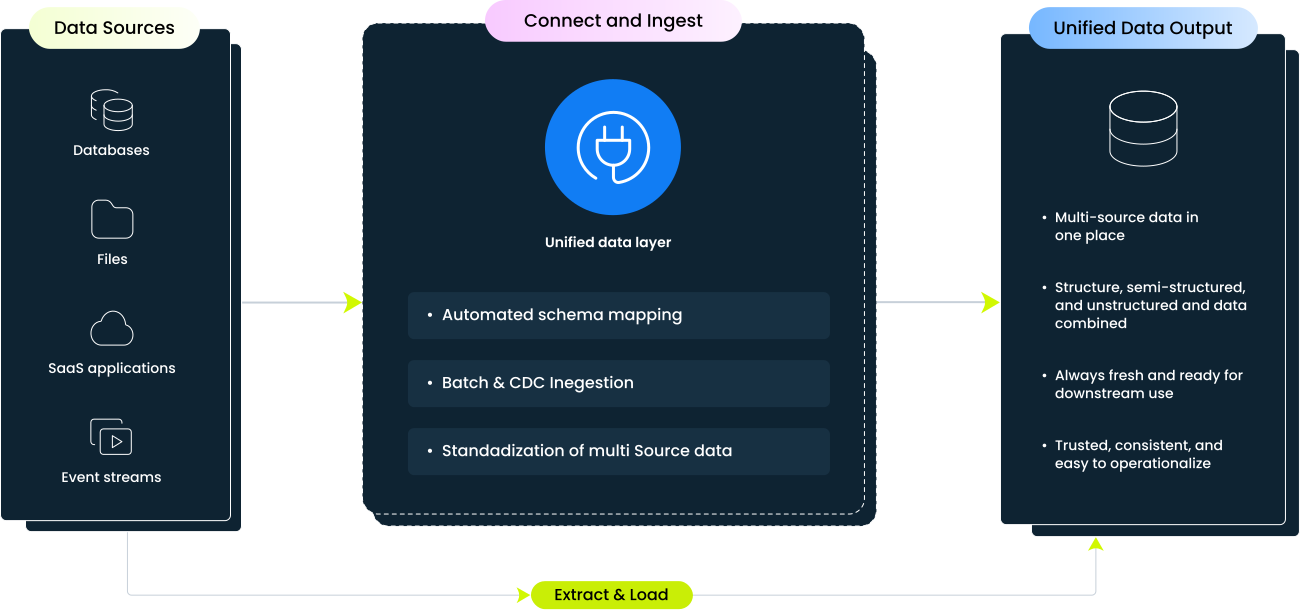
For all the context your AI needs
LakeStack brings every source, format, and ingestion mode into one system, so data enters your foundation structured, governed, and usable from the start.

Connect SaaS tools, databases, and ERP systems with pre-built connectors, and continuously sync data into your environment without building or maintaining integrations.

Ingested data maintains schema, relationships, and consistency. AI-assisted detection automates 90-95% of field mapping on first load, and adapts automatically when sources change.

Files, logs, documents, and semi-structured data are ingested alongside structured sources, with classification and metadata applied as part of the ingestion process.

Custom applications, APIs, and event streams are integrated through standardized interfaces, allowing real-time and event-driven data to flow into the same ingestion layer.

Batch, micro-batch, CDC, and streaming ingestion operate within a single system, where data movement follows a consistent flow regardless of how each source updates.
Connect everything. Maintain nothing.
LakeStack brings data from SaaS applications, databases, and operational systems into a single, governed foundation, so you don’t have to manage connectors, pipelines, or sync issues across tools.








Map your data sources before you build anything
A solution architect walks through every source system you need to connect and tells you plainly which ones are pre-built, which ones need configuration, and how long it takes. No sales fluff.
Not another ingestion tool
Most tools connect data. LakeStack removes the need to manage how it moves, changes, and stays usable over time.
Connect every source type, your way
Every environment is different. LakeStack supports the full range of enterprise source types and ingestion patterns, so whether your data lives in a SaaS tool, a legacy database, an ERP, or a file system, it flows into the same governed foundation without custom pipelines.
SaaS replication
Every SaaS app, Salesforce, HubSpot, Zendesk, Shopify, Stripe, and more, synced into one governed foundation, continuously and without custom integrations to maintain.

Database replication
Oracle, SQL Server, PostgreSQL, MongoDB, and more replicated via change data capture (CDC) into your lakehouse, so source systems always have a fresh, governed replica.
File replication
Bulk and incremental loads from CSV, Parquet, JSON, and XML sources via S3, SFTP, Dropbox, and local mounts with automatic schema handling and no manual pipeline work.
SAP replication
SAP ECC and S/4HANA are replicated into your cloud via CDC, capturing deltas, not just snapshots, so your analytics always reflect the current state of your ERP.
Reverse ETL
Push enriched, governed data back into the operational tools your teams work in: Salesforce, HubSpot, Zendesk, Intercom, so every system sees the same truth.

.png)
.png)
Frequently asked questions
For most enterprise sources with pre-built connectors, initial data flow is typically live within hours of configuration, not days. The timeline for full production readiness depends on the number of sources and the complexity of your environment, which a solution architect will map out during your architecture review.
No ongoing engineering ownership is required. Because ingestion runs as part of the foundation rather than as a collection of hand-built pipelines, your team is not responsible for monitoring, fixing failures, or re-implementing connections when source APIs change. That maintenance burden is handled within the system.
LakeStack supports ingestion from on-premise systems, including SAP ECC, legacy databases, and file-based sources via SFTP and local mounts, not just cloud-native sources. If your environment has a mix of on-premise and cloud systems, bring that to your architecture review, and we'll confirm coverage.
Monitoring, alerting, and recovery are built into the foundation. If an ingestion job fails, the system surfaces the failure with lineage context pointing to the root cause. Your team is notified and can act, but they are not responsible for managing the orchestration layer or rebuilding broken pipelines to recover.
No. LakeStack is priced as a one-time license scoped to your deployment, not on a per-connector or per-source basis. Adding new sources does not trigger additional licensing fees. The only costs that scale with usage are the cloud infrastructure charges on your existing cloud bill.
Ingestion is not a standalone step that hands off to separate tools. Classification, masking, lineage, and transformation begin the moment data enters the foundation, governed from the first record, not applied after the fact. There is no gap between what is ingested and what is governed.
Stop managing pipelines. Start using your data.
LakeStack brings your sources into one ingestion layer that stays structured, governed, and continuously in sync, without ongoing engineering effort.


